Two of these species belong to the family “canidae”. Although hyenas may look like dogs but are actually descended from cats. So lets proceed in the above order.
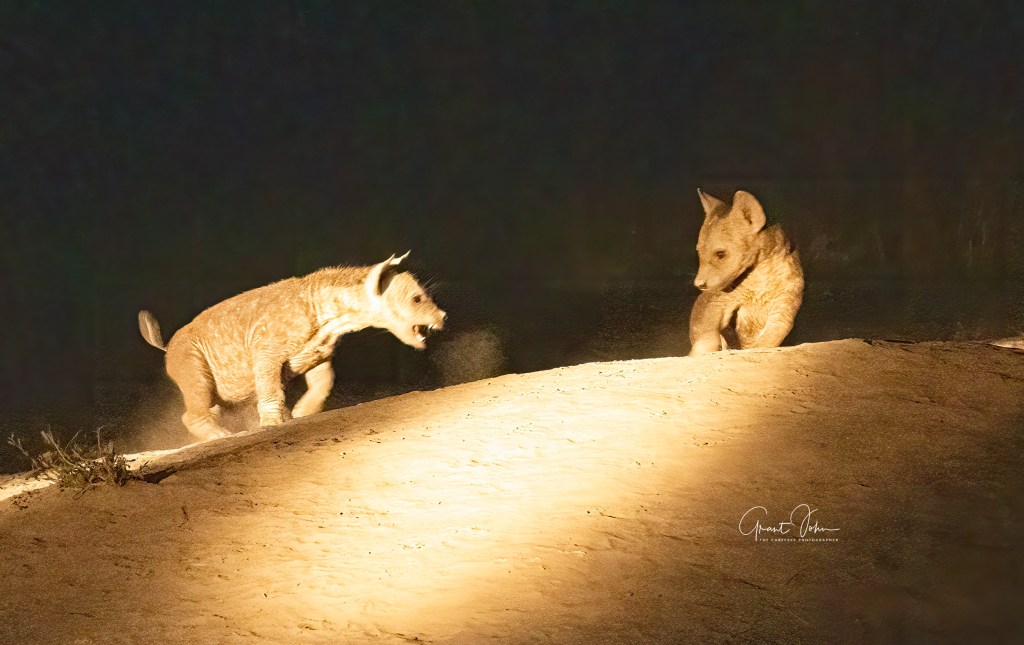
Hyenas

Hyenas are the fifth smallest family in the order Carnivora. They are unique and vital components of most African ecosystems. Both hyenas and canines are non-arboreal, curatorial hunters that catch prey with their teeth rather than claws. Both eat food quickly, and their calloused feet are adapted for running and making sharp turns. Their other habits including grooming, scent marking, defecation routines, mating and parental behavior are consistent with feline behavior.
The four species are the striped hyena, the brown hyena, the spotted hyena and the aardwolf (already covered). Spotted and brown hyenas live primarily in sub-Saharan Africa, and are very common in Botswana. They are noted for their scavenging habits.
Hyenas have long forelegs and powerful neck and shoulders for dismembering and carrying prey. They are tireless trotters with excellent sight, hearing and smell for locating carrion, and they are proficient hunters as well. They are all more or less nocturnal.
Intelligent, curious and opportunistic in matters of diet, hyenas frequently come into contact with humans. Spotted hyenas range south of the Sahara except in rain forests. They are ginger colored with patterns of dark spots unique to each individual. Females at=re larger than males, weighing up to 180 pounds and measuring up to 6.5′ long. They communicate with moans, yells, giggles, and whoops, some carrying several kilometers.
Gestation is about 110 days, annual litter size is usually two pups. They hunt everything from young hippos to fish; antelopes are common. In southern Africa they kill most of their own food, hunting effectively in groups.Strong jaws and broad molars allow the animal to get at every part of a carcass and crush bones, which are digested in the stomach by highly concentrated hydrochloric acid.
They live in clans of 5-80 individuals, and mark their territory with dung piles and scent from anal glands. The sexes have a linear dominance hierarchy, the lowest female outranking the highest male.
The smaller brown hyena weighs about 40 ; the coat is shaggy with an erectile white mane over the neck. Birds and eggs, insects and fruit are staples, but leftover kills by lions, cheetahs and spotted hyenas are important. They also live in clans, but adult females nurse each other’s cubs, other clan members take food to the cubs, and females do not outrank males.

Jackals

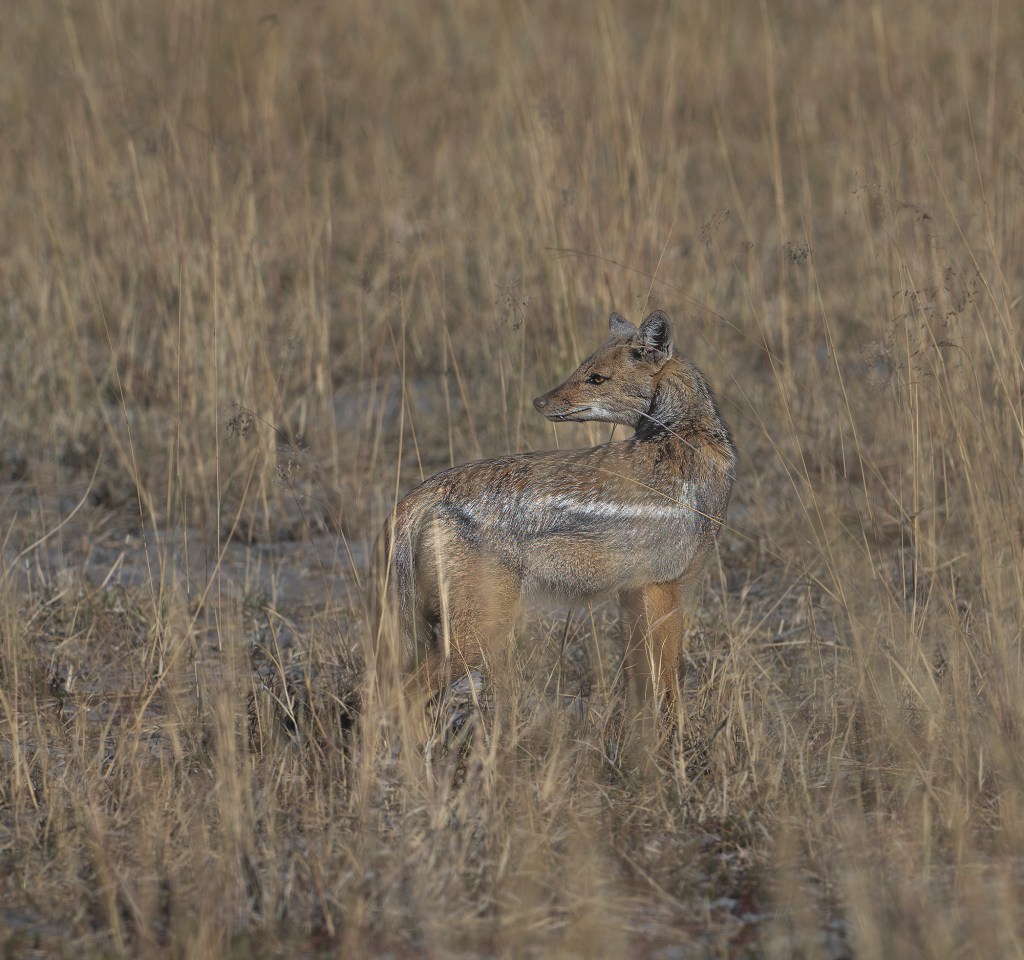
Jackals are canids native to Africa and Eurasia. The name commonly refers to three species: the closely related black-backed jackal (above) and side-striped jackal of sub-Saharan Africa, and the golden jackal of Europe and Asia.
All jackals are opportunistic omnivores, predators of small to medium sized animals and proficient scavengers. Their long legs and curved canine teeth are adapted for hunting small mammals, birds and reptiles, and their large feet and fused leg bones give them a physique well-suited for long-distance running. Jackals are most active at dawn and dusk.
Jackals in Africa prefer to live in the open and wooded savanna, in grasslands, shrub lands and along waterways with dense undergrowth. They are 17-25 pounds in weight and 27-33 inches in length.
Their most common social unit is a monogamous pair, which defend their territory from other pairs by vigorously chasing intruders and marking landmarks with their urine and feces. Gestation period is about two months. They live in burrows, litters containing two to seven pups.
Primary predators are leopards, hyenas and eagles.


Bat-eared Fox
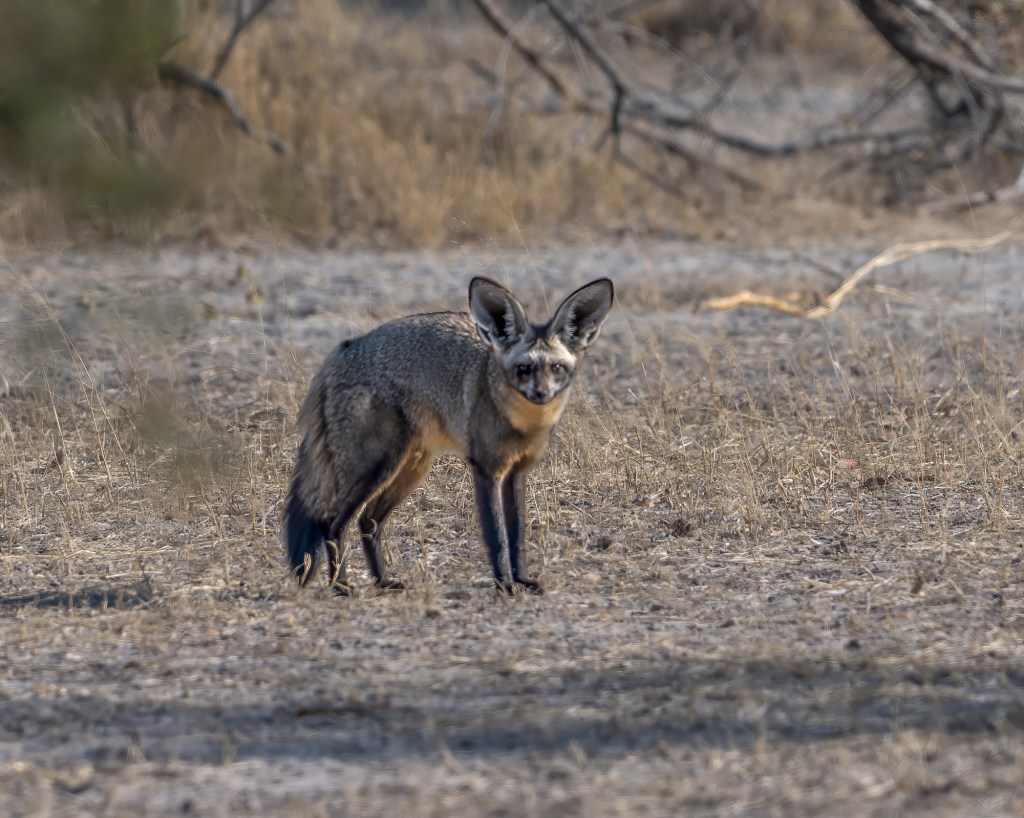
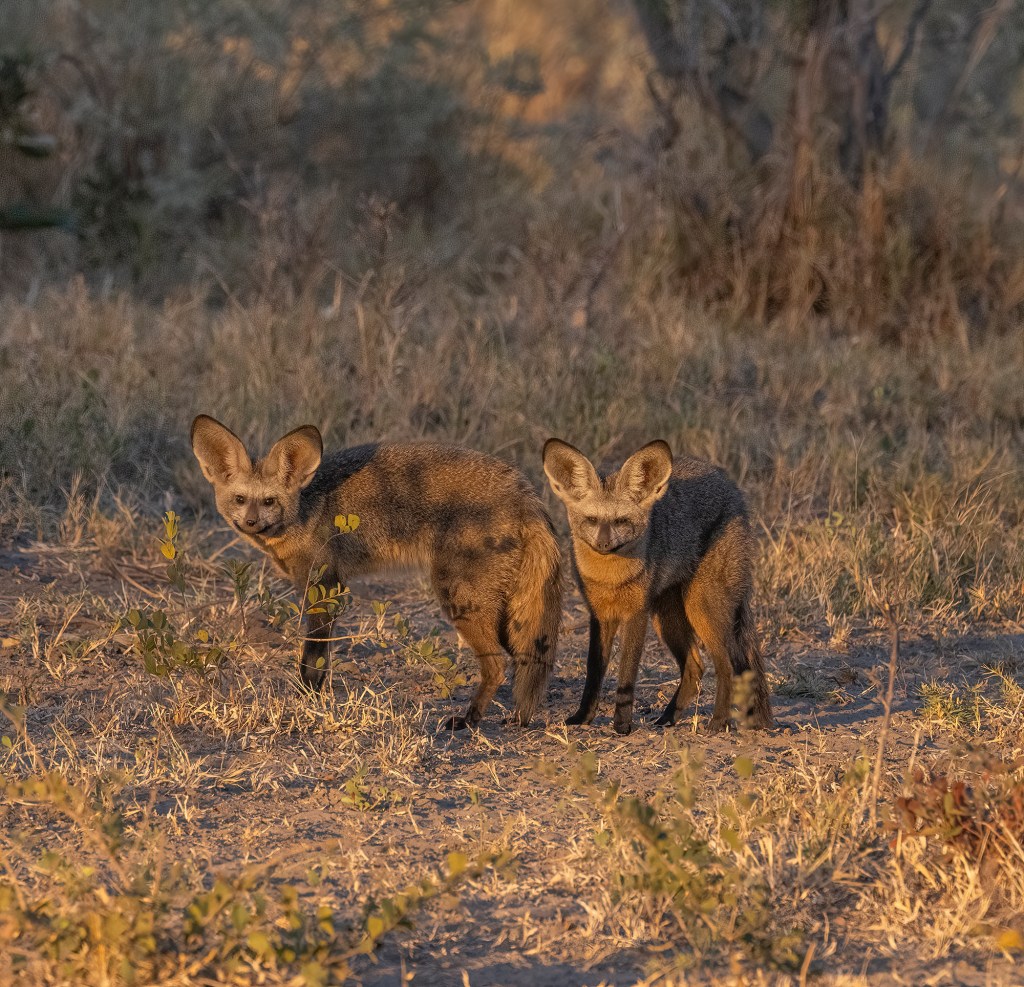
The bat-eared fox is a small, African fox known for its enormous ears, which are over 5 inches tall. The ears are full of blood vessels that shed heat and help keep the fox cool; they also give the fox a very goo sense of hearing.
Bat-eared foxes are sandy gray withe lighter fur on the belly and darker fur around the eyes, muzzle, back of the ears, feet and tip if its large bushy tail. The inside of the ears and a band across the forehead are white of buff.
They are not territorial. A family has several den holes with many entrances, tunnels and chambers. They can create their own or enlarge an abandoned one. Predators include eagles, jackals and hyenas.
They eat insects, with termites up to 79% of its diet. They also eat dung beetles and their larvae, grasshoppers, scorpions, lizards, fruits and eggs. They have more teeth (46-50) than most mammals. They typically live in pairs, with other females and their pups and a male fox.
They tend to hunt for termites late in the day and at night, spending most days in their dens. These foxes are fairly common in southern Africa.


 The Carefree Photographer